
Scale EV Roaming.
Control Exposure.
Release Working Capital.
ChargeStream is clearing and settlement infrastructure for EV roaming networks.
Built for Charge Point Operators and e-Mobility Service Providers, ChargeStream converts fragmented roaming activity into deterministic clearing and daily net settlement - reducing gross exposure, improving capital efficiency, and strengthening treasury control while structuring roaming like regulated payment infrastructure.
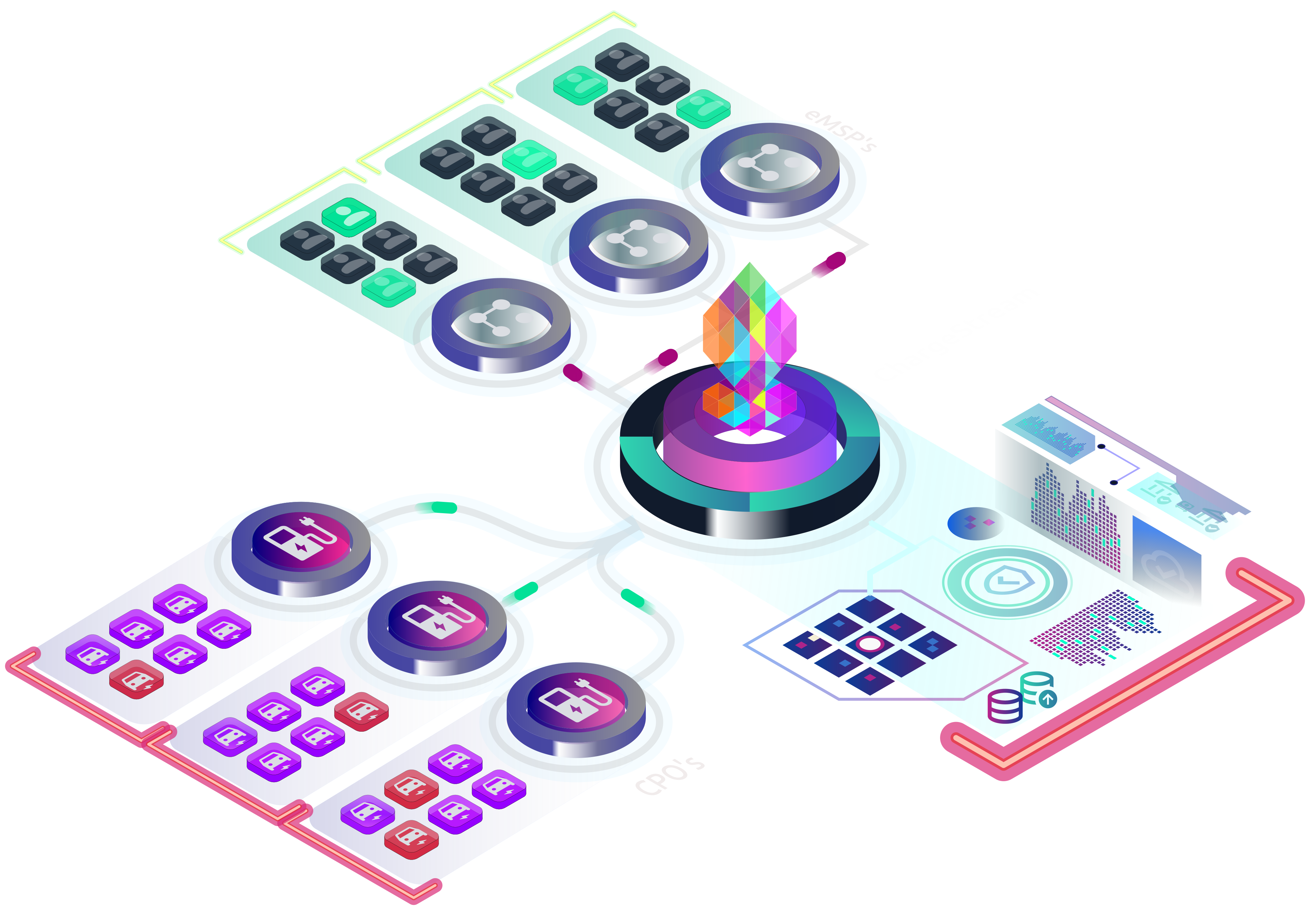
Sitting behind connectivity and CPMS platforms, we operate the clearing and settlement layer, transforming exchanged Charge Data Records (CDRs) into net positions across counterparties.
Operating with banking and regulated payment institution partners, participants are provisioned with addressable settlement accounts through which automated, real-time funds transfers occur over open banking payment rails.
One Financial Source of Truth
Because finance requires certainty
EV roaming sessions involve 3–6 parties per transaction, generating millions of Charge Data Records every month at scale. Most platforms exchange data. They do not create financial certainty.
ChargeStream converts raw Charge Data Records into deterministic settlement positions - who owes whom, how much, and when - every day.
No reconciliation drift. No spreadsheet dependency. No margin erosion.
Ask yourself
If challenged today, could you state your exact daily net settlement position across all counterparties?
How much financial exposure increases every time you add a new counterparty?

Stop Financing the Ecosystem
Turn settlement timing into capital advantage
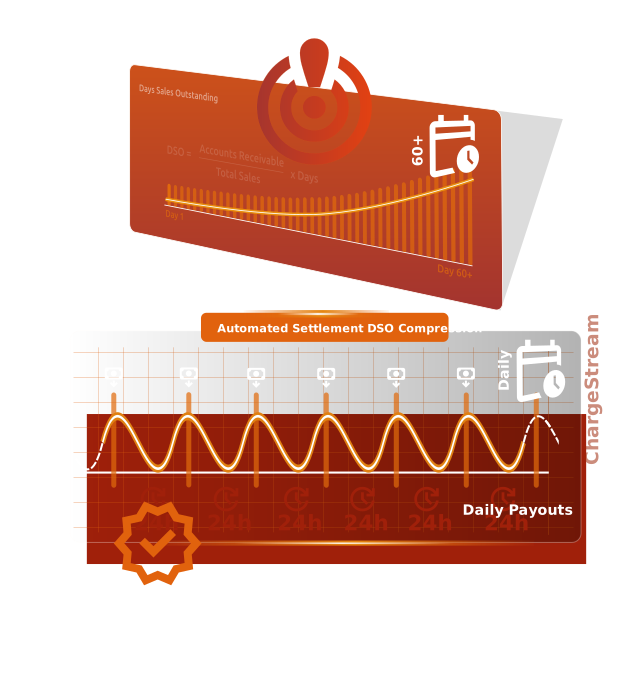
Roaming settlement cycles often run 30–60 days, forcing operators to carry material working capital and counterparty exposure.
Multilateral clearing converts fragmented bilateral transaction flows into a single net settlement position per participant, dramatically reducing settlement complexity and liquidity exposure (See FAQ). ChargeStream enables intraday clearing and interday settlement, aligning cash movement with value delivery.
Shorter cycles reduce balance sheet drag. Predictable timing improves treasury planning. Capital is released back into growth.
Ask yourself
Why should your balance sheet fund someone else’s settlement delay?
What could daily settlement unlock for your balance sheet?
Scale Without Operational Headcount
Growth without spreadsheet debt
In roaming, operators typically add 1 finance or ops hire for every 2–3 new partners. That model scales cost linearly with growth!
ChargeStream automates clearing, netting, and settlement at the platform layer, so partner growth does not require process expansion.
Growth becomes predictable. Margins improve with scale. Key-person risk disappears.
Ask yourself
Does your roaming partner growth improve your margins - or quietly erode them?
If your most experienced ops manager left tomorrow, Would payments and billing still operate predictably?

Payments-Grade, Not “Platform” Grade
Built for audit scrutiny, not reconciliation guesswork
Most roaming platforms exchange data and reconcile later. Payments infrastructure does not guess - it applies double-entry accounting and deterministic rules from the outset.
ChargeStream executes the same structural principles used in regulated payment systems. Settlement structure is enterprise risk management.
Explicit liability ownership. definitive outcomes. Audit-ready financial traceability.
Roaming is treated as money - not metadata.
Ask yourself
If challenged by an auditor today, could you explain - step by step - how every roaming euro is accounted for?
Do your settlement numbers come from Canonical rules, or from reconciliation after the fact?
Roaming growth compounds contractual and financial risk.
ChargeStream replaces fragmentation with predictable financial structure.
The Current Reality of EV Roaming.
Roaming grows revenue. It also multiplies financial complexity
Every new counterparty introduces another bilateral agreement, another pricing logic, another reconciliation surface. What begins as three partners becomes thirty - and with each one, exposure compounds.
Most roaming platforms exchange data. They do not create financial certainty.
Bilateral agreements everywhere
Each roaming partner operates on different commercial terms, settlement timing, fee structures and dispute processes. As counterparties scale, so does operational variance - and so does financial risk.
Month-end reconciliation cycles
CDRs are aggregated and disputed weeks after the charge. Revenue certainty lags operational reality. Finance operates in hindsight.
Gross exposure builds silently
Revenue is recognised before cash is settled. Net positions remain unclear across multiple partners, increasing working capital requirements and counterparty risk.
Spreadsheet pricing logic
Tariffs, VAT treatments, FX conversions and special partner terms live in unmanaged spreadsheets. Institutional knowledge becomes person-dependent and difficult to audit.
Treasury visibility gaps
Without definitive daily netting, treasury lacks a real-time view of aggregate exposure across the roaming network. Liquidity planning becomes reactive instead of controlled.
Dispute loops and rework
Minor CDR interpretation differences create repetitive reconciliation cycles. Each dispute consumes finance and operations capacity while quietly eroding margin.
FX / VAT inconsistency risk
Cross-border roaming introduces currency conversion timing differences and tax treatment variation. Small inconsistencies compound across high transaction volumes.
Audit surfaces multiply
Every additional counterparty increases control requirements, documentation effort and exception handling. Governance complexity scales faster than transaction volume.
EV Roaming is not a data problem. It is a capital and control problem.
What changes with ChargeStream
Today
Month-end billing / reconciliation
Positions confirm late after aggregation and dispute cycles. Cash collection extends into 30/60/90-day terms.
Spreadsheet pricing logic
Rules live outside controlled systems, creating drift and key-person risk.
Exposure builds silently
Revenue recognised before cash certainty exists across the roaming chain.
Disputes and rework
Interpretation differences create repeat reconciliation loops.
With ChargeStream
Deterministic daily net positions
Daily positions computed by rule, consistent across counterparties.
Intraday clearing → structured net settlement
Clearing runs continuously; settlement executes on defined cadence.
Governed pricing, VAT & FX engine
Rules codified and versioned inside a controlled system.
Controlled liability & audit trails
Clear ownership, traceable postings, and evidence built in.
Engineered for Clearing at Scale
Structural Architecture
1. Data Ingestion - CDR Normalisation
Validate, normalise, and bind each CDR to party, contract, and tariff context at ingestion time.
2. Intraday Clearing Cycles
Deterministic intraday cycles compute provisional debit and credit positions inside fixed timing windows.
3. Cycle Aggregation & Summary Generation
Consolidate high-volume CDR flows into defined clearing positions per scheme participant.
4. Net Settlement Advisement Reporting
Consolidate cleared cycles into formal settlement advisements that state each participant’s net liability or receivable across the scheme.
5. Double-Entry Posting & Log Chaining
Post every clearing and settlement event through definitive double-entry journals with tamper-evident log chaining.
6. Net Settlement Funds Movements
Execute net funds movement aligned to settlement identifiers and ledger positions so cash matches computed reality.
How we Automate the Clearing and Settlement Stream
From Fragmented Multilateral Invoicing to Structured Daily Clearing and Net Settlement
Settlement Lifecycle Visualisation - Intraday Clearing to Net Cash Execution
Intraday Clearing Cycles
CDRs are ingested, validated, normalised, and aggregated into ledger-aligned clearing positions throughout the day.
Exposure Compression
Bilateral gross roaming exposure consolidates into a single deterministic net position per counterparty.
Settlement Identifiers
Each net obligation is assigned a settlement ID - linking clearing records, advisements, and ledger postings.
Cash Alignment
Funds move only against computed net positions, ensuring cash matches the ledger - not invoices.